
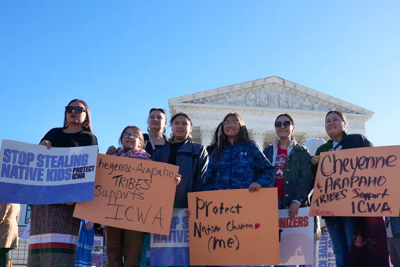
The ruling was completely unexpected. By a 7-2 vote on June 15, the U.S. Supreme Court upheld the Indian Child Welfare Act.
It is a major victory for Indigenous tribes and their right to remain sovereign nations, their people controlling their own destiny and their children to stay in their own culture.
Many people simply do not understand the importance of the ICWA or the Supreme Court’s upholding of it. In a nutshell: Each Native American tribe is a separate, sovereign nation and the act allows tribes the right to decide who adopts orphaned Indigenous children who are born members their nation.
The 1978 law was passed after generations of Indigenous children being given to non-Native families because courts and other people did not believe Indigenous people had the ability to raise the children in a safe environment. Prior to the law, individual tribal culture and the rights of the tribe as a sovereign nation were ignored.
Before the ICWA, it is estimated that 25% to 35% of Native American children were taken from their homes and given to white families or placed in boarding schools to assimilate them, erasing their culture.
As a result, many tribes forever lost children, often decimating the nation’s enrollment. These children may have grown up never knowing their true ancestry, and as the generations passed, the knowledge of that culture became lost.
For those who question how severe this could become, look to the Kootenai Tribe of North Idaho. By the mid-1970s the tribe had lost so many children to such adoptions and placements that they were down to 67 members, many of whom were living in poverty because the tribe was ignored as a non-recognized tribe by the federal government.
In 1974, then-Chief Amelia “Amy� Tice declared war on the United States government so she could ask for federal recognition and save her people. Now known as the Kootenai War or Idaho’s Forgotten War, Tice was involved in a paper war where she was continually rebuffed by government officials when she persistently requested federal recognition.
It was a tense time in Idaho. To help raise money, tribal members said SH 95 was a toll road and (standing off the side of the road) asked people to pay 10 cents to drive it, raising several thousand dollars in the process.
Gov. Cecil Andrus sent the Idaho State Patrol to Bonners Ferry, Idaho, hoping to quell the war, but Tice held fast and finally was able to convince U.S. Sens. James McClure and Frank Church her people needed the federal recognition. Today, the Kootenai Tribe is flourishing and lost children are returning to the nation.
In the Supreme Court’s majority opinion, Justice Amy Coney Barrett said the majority rejected the petition of the Texas couple trying to adopt a Native child, saying Congress had the right to enact the ICWA, the pivotal question of the case.
In a separate consenting opinion, Justice Neil Gorsuch said the decision “safeguards the ability of tribal members to raise their children free from interference by state authorities and other outside parties.�
Celebrating the decision, a joint statement by the primary tribes involved in the lawsuit said the decision is a major victory for tribes and Indigenous children.
“We hope this decision will lay to rest the political attacks aimed at diminishing tribal sovereignty and creating instability throughout Indian law that have persisted for too long,� read a joint statement by Cherokee Principal Chief Chuck Hoskins Jr., Morongo Band of Mission Indians Chairperson Charles Martin, Oneida Nation Chairperson Tehassi Hill and Quinault Indian Nation President Guy Capoeman.
The Indian Child Welfare Act is an emotional piece of legislation. People who want to adopt children usually have good motives, but they cannot raise a Native child with all the knowledge of their culture unless they are part of that culture. Each time a child is taken from their home environment and given to a non-Native setting, another part of the tribes dies.
Yes, the law does somewhat give a preference to an Indigenous family even if the family is not the same tribe as the child; but that is between tribes as sovereign nations. It is not for the state or the federal government to decide.


