
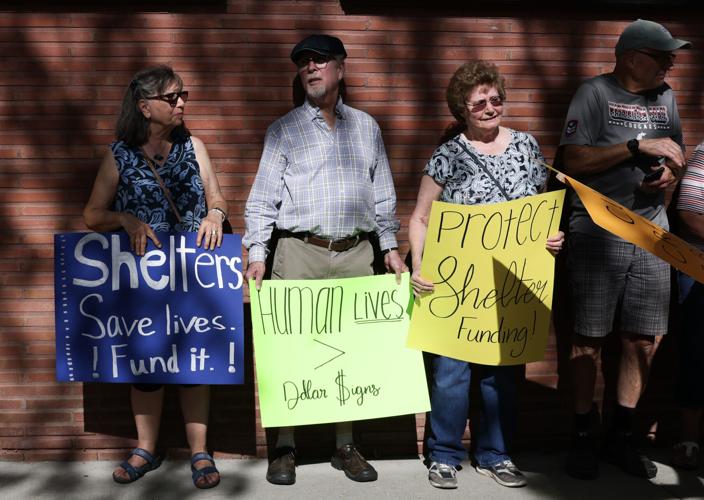

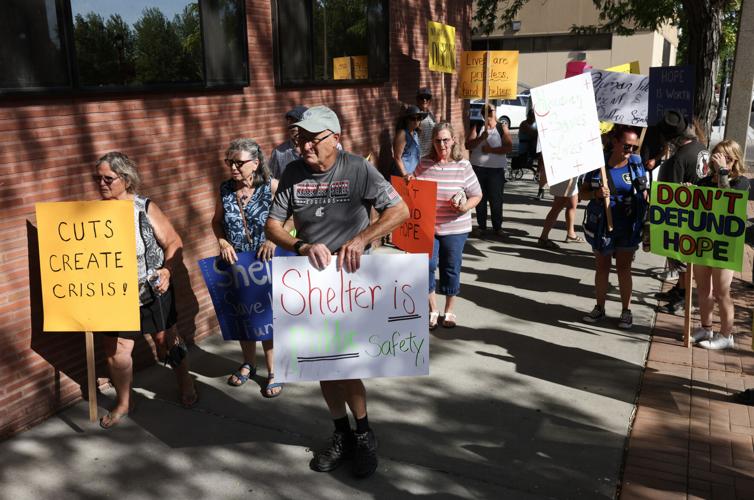

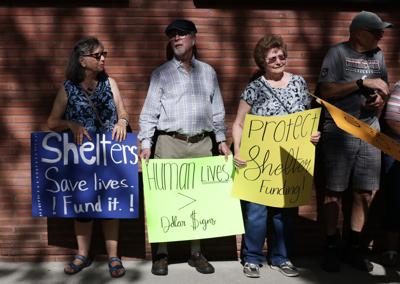
Yakima resident Brandy Morrow was clear about the importance of Camp Hope as she stood with protesters聽outside City Hall on Tuesday.聽聽
The sanctioned homeless encampment saved her life, she said.
"I have a completely new support system that I have never had before," she added. "I can be stable on (my own), instead of dependent on others. I have come out of my shell and been able to acquire a group of friends."
Morrow was one of about 35 Camp Hope residents who protested a county decision to cut funding to the homeless shelter before a Yakima City Council meeting. The homeless encampment houses people in tents, portable buildings and remodeled shipping containers near the city wastewater treatment plant.
In late June, the聽Board of Yakima County commissioners adopted a new list of funding allocations for homeless and housing services for the next two years.聽The county had $13 million to allocate, and more than $34 million in requests.聽
Camp Hope asked for $643,353 per year for its operations during the 2027 and 2028 fiscal years. It will receive $129,831 for the 2027 fiscal year, plus funding for outreach. It is receiving about $200,000 annually for complex case management from separate county mental health sales tax funds.聽
While the decision came from county commissioners, not the City Council, Camp Hope Executive Director Mike Kay hoped council members would use their influence to support the encampment. Council members unanimously agreed to allocate $50,000 to temporarily sustain Camp Hope until a better solution is found.
Kay said the county cuts will force him to cut down to 50 beds. He added that the shelter fluctuates between 120 and 195 beds in use and currently has 130-140 residents.聽
The sanctioned encampment, overseen by Grace City Outreach, can accommodate up to 250 people. In addition to reducing beds, Kay said that he'd also have to lay off聽almost nine staff members.
The county received less funding from the state, and sanctioned encampments weren't eligible for state funding.
"There's still mental health tax dollars," Kay said. "It was designed to be able to take care of the population we're trying to take care of."
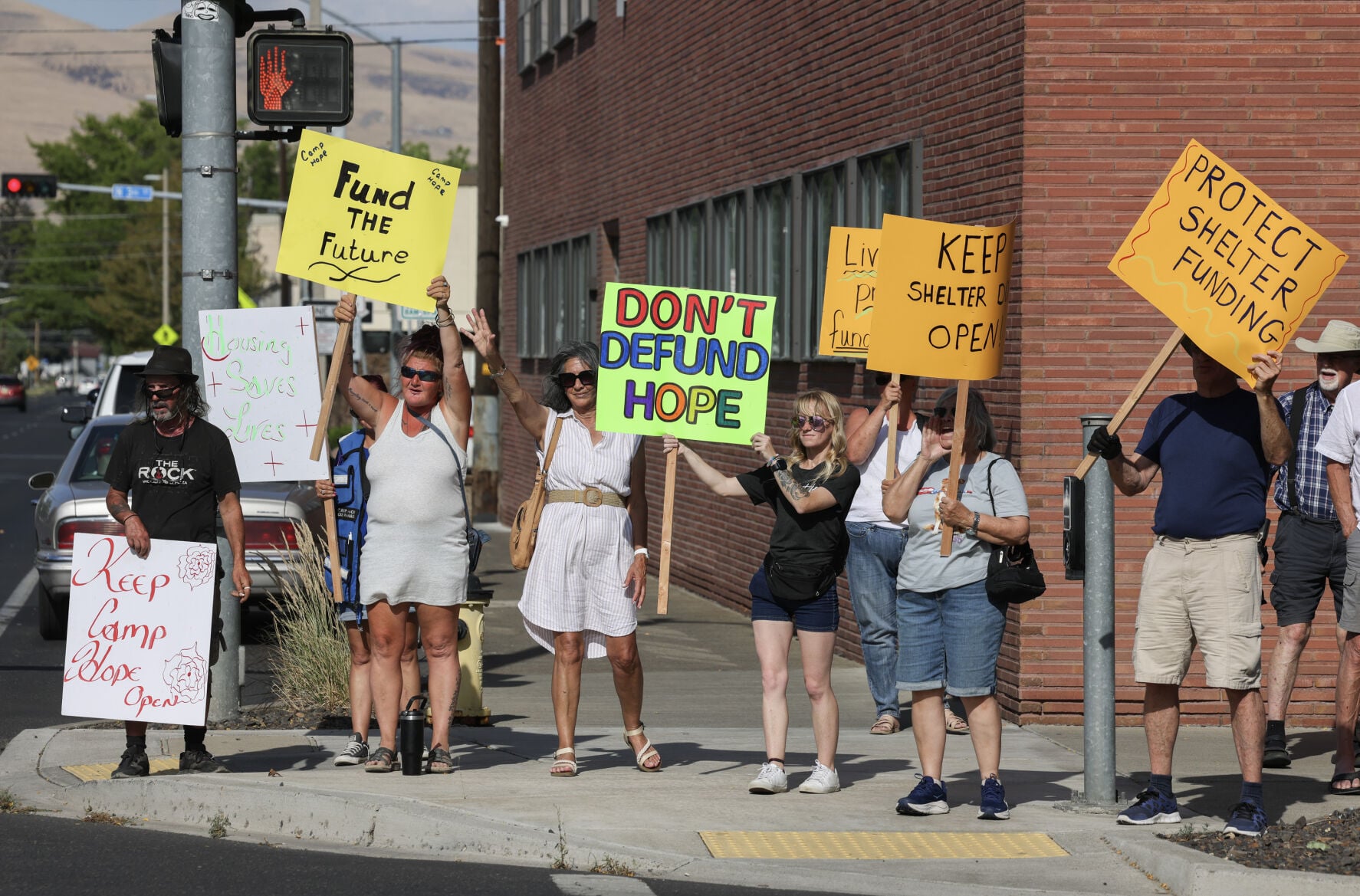
About 40 people rally in support of Camp Hope in from of Yakima City Hall Tuesday, July 7, 2026, in Yakima, Wash.


The impact to Camp Hope
Morrow has been a resident of the shelter for 2 1/2 years. Before that, she was homeless for nearly five years, living in her car then near Rest Haven in the Terrace Heights area, she said.聽
She initially refused help because she was in the middle of a mental breakdown, she said. She lost connections with her brother, her boyfriend, her kids, and was struggling with addiction and a severe kidney infection. But she couldn't receive necessary surgery until she had a place to stay.聽
The first time Morrow stayed at Camp Hope, she walked out. She couldn't handle staying in a tent or being around people after being isolated for so long. The second time, she was offered a Compassion Cabin聽鈥� a single room for her and her two dogs聽鈥� and things were different.聽
"Since then, I dropped the drugs at the gate," Morrow said. "I am now just over 2 1/2 years clean and sober."
Council members recognized the impact that Camp Hope was making in the community, and for its residents.
After approving the temporary funding, council members unanimously approved聽a vote of no confidence聽in the Yakima County Board of Commissioners' Homeless Housing Assistance Program funding allocation for the 2027-28 biennium. The council took a similar no-confidence vote in the Yakima County Homeless Coalition last year.
Morrow said that being at Camp Hope has given her mental health support, a case manager and a doctor for her kidney infection. She has grown as a person and is no longer ashamed of her mental health struggles and being around people.聽
It took Camp Hope nearly three years to get her in there because of her trust issues, she said.聽
"I trust Mike Kay with my life," Morrow added. "If that place didn't exist, I have nowhere to go. Me and my dog would be on the street."
Public comment聽
The city council chambers were filled with people, some of whom migrated to the lobby to watch the meeting from the outside. People expressed their concerns about Camp Hope and why the council chose to fund Flock cameras that could have gone toward the encampment.聽
During public comment, Kay spoke about the importance of Camp Hope.聽
"As you know, from your own police chief, we are not a high crime shelter," he said. "Also echoed by the sheriff and by your fire services as well."
The Yakima County Human Services Department, the Yakima County Sheriff's Office and Rod's House had voiced support to the county commissioners and the grant review committee, he added.聽
"I'm not mad at the commissioners," Kay said. "But at the end of the day, we have people down there that are going to end up on your city streets."
Camp Hope is left with no other option but to cut beds, he added.聽
"They'll call us to pick up human fecal matter," Kay said. "But they won't return a call as to other funding sources, and so on, that we can access before we go this route."
He criticized the commissioners' decision to fund a project that is yet to be completed, while cutting programs that people currently rely on.聽
Liability insurance alone costs Camp Hope聽$9,653 monthly, while commissioners allocated only $129,831 for 2027, Kay said.聽
Shawn Boyle, Yakima's police chief, said that Camp Hope reducing beds would lead to a significant increase of people in the downtown area. Their presence could increase camping, nuisances and fires, and negatively impact the area.聽
"People have pets and things like that, that are unable to be brought into other types of facilities," he said.

About 40 people rally in support of Camp Hope in from of Yakima City Hall Tuesday, July 7, 2026, in Yakima, Wash.
Commissioner's response聽
Yakima County Commissioner Kyle Curtis attended the meeting, and spoke about the decision.
"Often at times we have to make decisions," he said. "Difficult decisions that reflect the realities of today."
The county spent more than a month deliberating over how to allocate its funding among 41 applicants, the most the county has received for homeless services, Curtis added.
"The community spoke. They were tired of (the) status quo; they called for big things," he said. "Big things mean moving people out of shelter into long-term solutions."
Curtis said there is concern about the transition, but the reality is that transition is hard. His appearance at the council's meeting should reiterate his commitment to Yakima, and his willingness to help the mayor and staff navigate through the funding shortage, he added.
"I believe that the commissioners, to the best of our ability, put forth your tax dollars in the best way possible that achieves the outcomes that this community has approved through (the) five-year plan," Curtis said.
The county's new , which was put together with community input,聽places聽greater emphasis on ensuring that people experiencing homelessness can get out of their situation as quickly as possible. The plan's new initiative prioritizes long-term housing over short-term shelters.聽
"It's not always housing, it may be a work program, it may be treatment, it may be all of these things," Curtis said. "But before we can get to that state, we have to address this large population that's been sitting in shelter for so long."
The next step is to improve shelter services, including intensive services from day one and a case manager. But for state and federal dollars, some programs can't be tapped into unless a person meets a chronic homelessness requirement 鈥� meaning they've been聽unhoused for at least a year, he added.聽
"We have a good portion of that population that meets the definition of the state to access state long-term care dollars," Curtis said. "And so that's why we're trying to move this population from shelter into long-term care."
Although Camp Hope is an emergency temporary shelter, it provides services, including case managers who connect people with resources such as聽permanent housing, medical/mental health support, and substance abuse treatment.
More than $800,000 was allocated to the former St. Elizabeth Hospital, where Trouves Health Care Corp. plans to establish 115 new beds to help transition people into long-term care.聽
The project is months away from completion, but Curtis said that he believes "as a community we will navigate the shortfall."
Council discussion
Council members expressed concern about disparities in funding for homeless services programs and how Camp Hope's funding reduction could impact the city.聽
The county allocated聽$1,274,000 to聽Union Gospel Mission of Yakima for 2026-29, while Camp Hope received 20% of what it had asked for.聽
"It concerns me," Council member Patricia Byers said. "Because if they think that the 150 people that are leaving Camp Hope are going to go to the mission, the mission doesn't have that capacity. So again, we have people on the street."
Byers also questioned the transparency of the county commissioners. Two years ago, when she was a part of the scoring committee, she said that Camp Hope scored high, but funding was still cut from the organization.聽
She praised the commissioners, adding that the five-year plan to end homelessness is a wonderful goal, but achieving it will require a step-by-step process. It can't be done overnight.聽
Council member Rick Glenn commended Camp Hope for the work they're doing. He advocated for supporting them, leading to the council member's motion to approve up to $50,000 for the organization as a temporary solution.聽
"The key thing that I'm looking at is that we are in a situation now where our homeless situation here in Yakima looks better than it has in years," he said.
Mayor Matt Brown said that Camp Hope scored well again this year, though he recused himself from the executive board of the Yakima County Homeless Coalition due to a potential conflict of interest.聽
"In the five-year plan, the goal was to change the way we do some of the encampments and shelters and stuff like that," he said. "But it's a five-year plan, it's not done in 25 days, and it's not done in five minutes."
Brown showed concern over the transparency of a proper transition plan. During the wintertime, when Camp Hope is near capacity, he questioned where people will go instead.聽
"Camp Hope really does serve a huge need," Brown said. "Not just in our city, but throughout the whole region."
The city council invited Curtis back to its next council meeting on July 14 to continue the discussion.







(0) comments
Comments are now closed on this article.
Comments can only be made on article within the first 3 days of publication.