
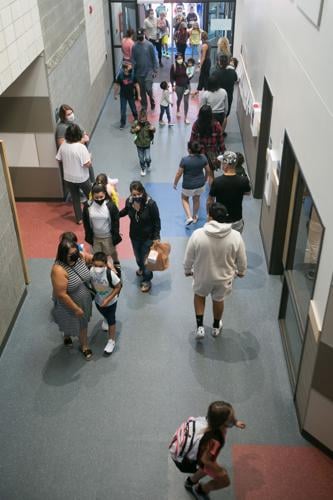

At a crowded forum of West Valley community members in mid-October, person after person walked up to the podium to make their voices heard. Some were passionate. Some received cheers of support. All had opinions. West Valley school board members dutifully listened.
They were there to discuss what School Board President Mark Strong called a 鈥減leasant problem鈥�: how to spend a $19 million surplus from a bond that paid for two new elementary school buildings.
Some people wanted the district to give all the funds back to the community. Others supported the district using it on new projects, including nearly $14 million in maintenance projects the district shared at the forum. Some believe there could be a happy middle between the two.
At the end of the forum, board members had no consensus on what to do with the money. In an interview, Strong said the decision-making process will likely take a while, as board members explore the options.
An unexpected boon
In 2019, local voters approved a $59 million bond for the West Valley School District to construct new buildings for Apple Valley and Summitview elementary schools. It was a narrow victory, passing by about 70 votes.
Construction on the new elementary school buildings lasted about two years and the buildings opened for the 2021-22 school year. The district initially estimated the project would cost about $64 million, Strong said. But it ended up costing only about $55 million, said assistant superintendent William Connolly. The district also received about $13 million in state matching funds. The exact figures plus interest take the surplus total to $19 million, school officials said.

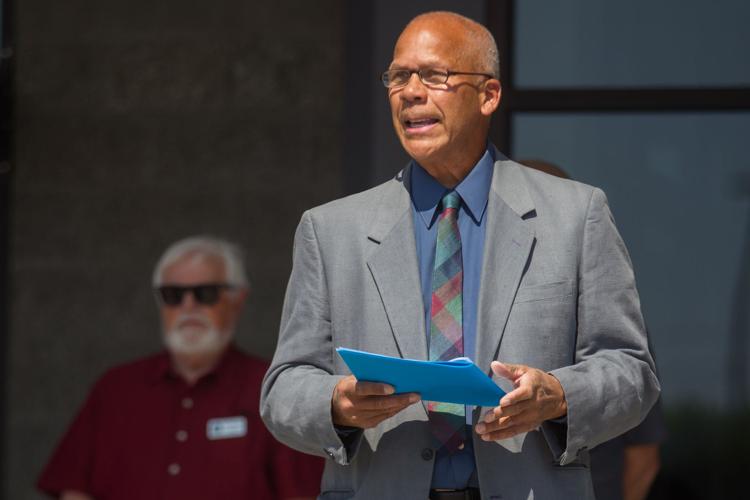
West Valley school board President Mark Strong speaks during a ribbon cutting ceremony for the new Summitview Elementary School building Monday, Aug. 30, 2021, at 6305 W. Chestnut Ave. in Yakima, Wash.
Strong said several factors contributed to the low project price tag. The district used the same design on both buildings. There was strong interest and 鈥渁ggressive bidding鈥� by contractors, and the district got a surprisingly low bid. Contractors started work early and saved money throughout the project. In one example, the district anticipated it would cost $2 million for demolition and abatement to tear down the old buildings, and the cost was closer to $1 million.
Another factor was that construction continued uninterrupted for about two years because there were no students in those buildings. The Summitview and Apple Valley students attended classes virtually during the start of the pandemic and then in-person at the district鈥檚 then-freshman campus, which now serves as the Innovation Center. Having students at the elementary campuses would have increased the district鈥檚 insurance payments and forced builders to work around the students.
鈥淭hat was a tremendous savings right there because the project can move ahead full speed without any delays or slowdowns of our own making,鈥� Strong said.
This move shortened the total length of the project, contributing to cost savings.
School officials anticipated something of a surplus on the project, but the $19 million came as a pleasant surprise, Strong said.
The options
The school district has three options for what to do with the surplus bond money. Board members asked speakers at the forum to indicate which option they preferred. It was an informal way to gauge community interest.
Option one is to give all the money back to taxpayers through a multi-year defeasance strategy. A homeowner with a house valued at $350,000 would see an estimated tax savings of $158 in 2023, with that number decreasing by a few dollars each year through 2027, according to a model plan passed out at the community forums.
Option two is for the district to give back some of the money and use some of it for projects. If the district were to give back $9.5 million of the surplus, a homeowner with a $350,000 house could see about $77 in tax savings in 2023, with that number decreasing slightly until 2027.
No plans have been finalized and the details could change.
Option three is for the district to keep the surplus funds and use them on various projects. The district estimated the funds could accrue an additional $814,000 in investment earnings between now and 2026.
At the forum, district officials passed out a list of capital projects totaling nearly $14 million. That included the high priority, $250,000 well replacement at Mountainview Elementary School, a $500,000 project to replace water piping at the midlevel campus and a $7.8 million replacement track and football field for the high school.
Other projects, like roof repairs at some elementary schools and reconstruction of the two buildings that make up the midlevel campus, did not have an estimated price yet.
Several community members asked the board why the district had so many maintenance projects on its plate, with some projects apparently in limbo for years.
Strong, who has been on the board for about five years, said in an interview that there are many different priorities that come up for the facilities department to handle. The higher-priority repairs get handled first. The district budgets about $1 million annually for capital projects.
鈥淚t鈥檚 not enough but it鈥檚 what we have and what we can put into it considering all the other priorities going on in the school district,鈥� Strong said.
Community input
The district had two community forums in October to hear feedback on what to do with the bond surplus. Each one attracted dozens of community members. No clear consensus emerged.
Several community members supported option one to return all the money to taxpayers.
Don Kirby said he owns multiple properties in the area and felt defeasance would bring relief to local taxpayers. Lots of people are nervous about rising costs, and a tax break would help.
鈥淚 think it鈥檚 a moral thing that we return that back to the taxpayers so that we have credibility for the next time when the bond comes around,鈥� he said at the Oct. 18 forum.
Others who spoke in favor of returning money said it would build trust with the community and the district should have planned better for maintenance projects.
Many people also spoke in favor of the district making use of the surplus.
Community member Mark Anthony said he was worried about inflation impacting future funds raised by the district. He encouraged board members to make use of the money while they have it.
鈥淲e can have safety infrastructure, education programs, new skills for students to focus on, new types of classes, rather than returning the funds and then waiting on the next bond, waiting on the next levy, waiting on the next round of funding,鈥� he said.
Several speakers wanted to see investments in school safety.
Others said the money should go toward the middle level campus, which includes the junior high and middle school buildings. Voters rejected a bond proposal in 2017 that would have funded construction at Apple Valley, Summitview and the midlevel campus. West Valley parent Raquel Martinez said it makes sense to use the surplus funds to improve the midlevel campus, as was initially envisioned.
Multiple speakers brought up the idea of putting the options on a future ballot and letting voters decide. Strong said he was not certain how much that would cost, but the board is open to the idea.
Decision making
Strong said the board will likely take months to come to a final decision on what to do with the remaining bond funds. There was not consensus at the end of the community forum, with several board members still undecided. The board will need to get together and further discuss its options.
Strong expected there will be future hearings with the public on the matter. The district also has regular board meetings on the second and fourth Tuesday of each month with an opportunity for public comment. People who cannot attend in-person meetings can reach out to the district or board. Board members’ email addresses are available online at .
This is a difficult decision to make, but still a pleasant problem to have, Strong said. He knows not everyone will be happy with the final outcome, but whatever happens can only benefit West Valley.
鈥淭his is a win-win scenario for the community and the school district no matter what,鈥� he said.







(1) comment
Build a community swimming pool
Log in to reply
Comments are now closed on this article.
Comments can only be made on article within the first 3 days of publication.