
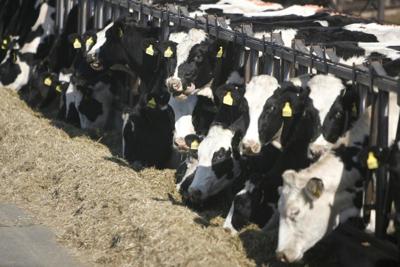

Federal authorities have filed a lawsuit in U.S. District Court alleging three large dairies north of Granger failed to adequately control nitrate contamination from their operations.
The U.S. Environmental Protection Agency and the Department of Justice filed the lawsuit Wednesday, . The EPA alleges that the dairies, which collectively have more than 30,000 animals,聽have failed to comply with a legal agreement they entered into with EPA in 2013.
The operations include the Cow Palace, DeRuyter and Bosma dairies.
The 2013 agreement aimed to reduce nitrate leaching from their facilities and protect nearby residents with nitrate contaminated well water, according to the news release.
Efforts to reach representatives of the DeRuyter and Bosma dairies were not successful. Yakima attorney Brendan Monahan represents the Cow Palace. He noted that Cow Palace, like the other dairies, was required to follow "a broad array of duties and obligations." He listed several of those, among them lagoon and catch basin lining and field application controls with limits on nitrate and phosphorus levels.
"Cow Palace has successfully completed 100% of the foregoing obligations. .... Its fields are 100% in compliance, and have been for many years, easily surpassing even the most stringent nitrate and phosphorus goals. Its lagoons are double-lined with state of the art leak detection technology," Monahan said in an email. "It is an absolute model for the industry, worldwide."
As the complaint acknowledges, Monahan said, the testing requirements in the 2013 agreement expired under the agreement鈥檚 own terms after eight years. "Cow Palace and the other dairies have nevertheless volunteered to conduct and share exhaustive well monitoring data with EPA," he said.
The EPA has advocated for a more involved process, and the dairies have offered to engage in the agreement's dispute resolution procedures, Monahan said. But the EPA "has bizarrely refused to engage in the dispute resolution procedures," he added.
"And now, after two years of silence, and without even the courtesy of a phone call, it drops this ham-fisted and thinly-sourced complaint," he said. "The bottom line is that nitrate levels have dropped dramatically in all of Cow Palace鈥檚 fields and there have been consistent downward nitrate trends in the network of monitoring wells."
Nitrate containment crucial
Dairies generate large quantities of liquid and solid animal waste, which contains nitrogen that can turn into nitrate in the soil, the release said. Nitrates can migrate into groundwater if not managed properly and nitrate contamination may affect the drinking water wells of nearby community members.
High levels of nitrate in drinking water can be harmful, particularly for infants and pregnant women, according to the Lower 黑料福利社 Safe Drinking Water Initiative.
The 2013 agreement included requirements that the dairies provide a drinking water alternative to residents that use private drinking water wells with high levels of nitrate, control potential sources of nitrogen at the dairies and conduct quarterly groundwater monitoring.
The dairies performed quarterly groundwater monitoring for eight years and provided some residents with reverse osmosis filters, but didn鈥檛 complete all the actions required by the consent degree, the complaint said. Nitrate contamination is continuing based on recent monitoring data, it said.
The complaint mentions delays in lining and abandoning manure storage lagoons, leaking from some lagoons and overapplication of manure to fields, among other issues.
'Dairy cluster' case
A handful of dairies known as the "dairy cluster" entered a federal consent decree聽after being sued in 2013 by environmental groups, which blamed the dairy operations for high nitrate concentrations in Lower Valley drinking water.
The dairies entered the decree after a study by the EPA linked dairy practices to groundwater contamination. Under the decree, the dairies agreed to install double synthetic liners in manure storage ponds to prevent waste from seeping into groundwater and follow a stricter nutrient management plan when applying animal manure to fields as fertilizer.
Dan Wood, executive director of the , could not comment on a legal matter specifically. But in a statement, he said the state has "some of the most stringent regulations for water quality protection and some of the most extensive dairy regulations in the nation," and farmers have gone beyond those.
"Over the past 11 years, these farms have gone well beyond state regulations and invested millions of dollars to protect water quality. They have diligently worked to provide extensive paperwork to the EPA," he said.
"After millions of dollars of investment and 11 years of reports and visits from EPA, this is a blindside move by EPA," Wood said. "Surprising farmers with a news release and accusations is a poor way to communicate to these farmers and sends a poor message to the rest of the region's farmers.
Jean Mendoza is the executive director of the environmental group Friends of Toppenish Creek, which has sued Lower Valley dairies in the past. She said the EPA complaint points out the dairies have not properly lined or dismantled clay-lined manure lagoons that 鈥渉ave egregiously contaminated the soil below and around the soil and groundwater.鈥�
It also points out that the dairies have not shared information about the off-site transfer of manure, and some dairy fields still have soil tests that show overapplication of manure, she said.
People can report manure spills to the state Department of Agriculture at 1-800-258-5990 or the state Department of Ecology at 509-575-2490.
Editor's note: This story has been updated with comments from the Friends of Toppenish Creek.









(0) comments
Comments are now closed on this article.
Comments can only be made on article within the first 3 days of publication.