
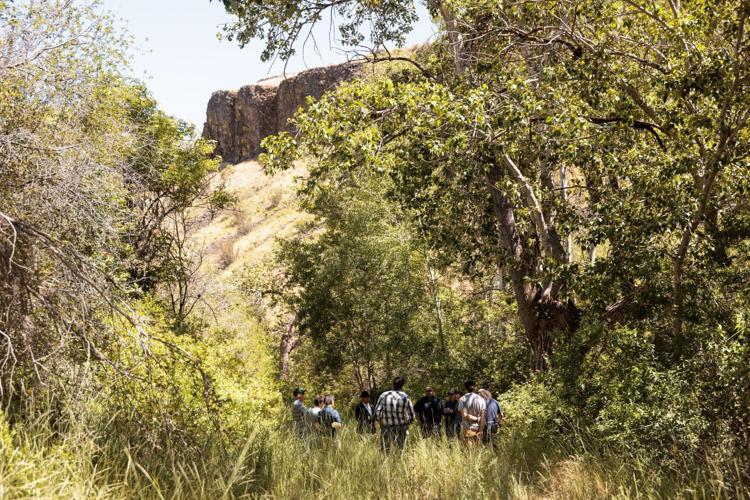
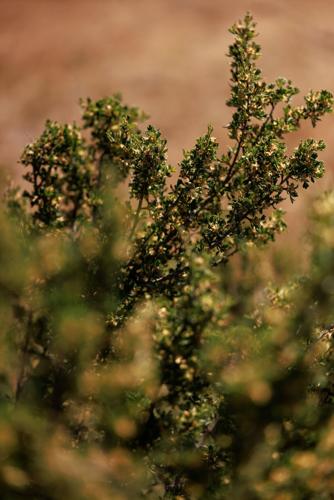
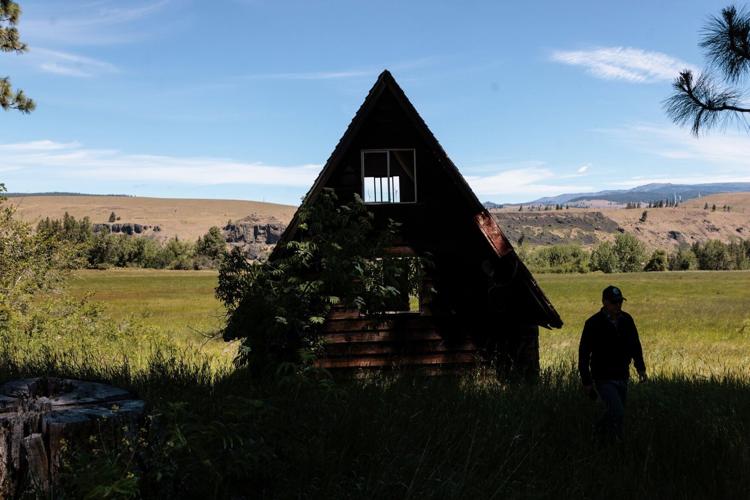

KITTITAS COUNTY 鈥� Aspen leaves quake in the clearing between a pair of basalt cliffs 100 feet high. An osprey soars overhead and cattle low on the dry, rolling hills above.
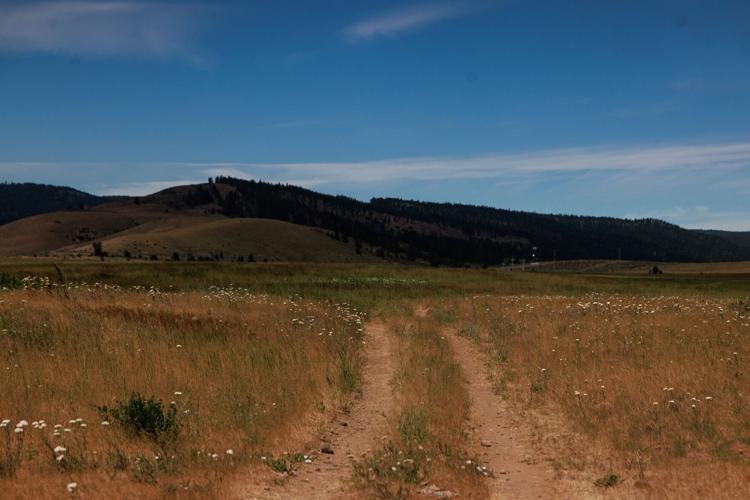
The ground is hard and dry this time of year. Tall grass takes on a golden hue and sways in the wind. Keep a close watch for rattlesnakes. Check for ticks.
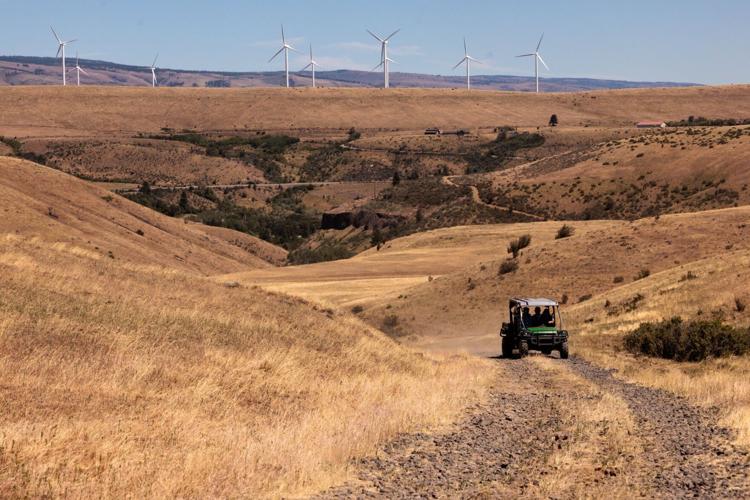
The scene might not last. Before long, the whole thing could be underwater. This particular basin, just off the south banks of the Yakima River, is the proposed site of Washington鈥檚 newest reservoir.听
The state is plunging deeper into , a phenomenon hydrologists expect in perhaps , and communities across the American West are watching their water reserves and lower.

A tour gathers at the Springwood Ranch, west of Thorp, Kittitas County, in June. (Erika Schultz / The Seattle Times)
The antidote to these 鈥� for one unlikely alliance in Washington 鈥� is to build a new reservoir, the state鈥檚 first in generations.
It鈥檚 a common enough refrain. Store more water in the wet months or years so it鈥檚 available when farmers, cities and fish need it most.
What makes this proposal unique is that it鈥檚 further along than similar attempts. The land is already bought and millions of dollars are at work in studying whether the site could hold billions of gallons of water. The work also has broad support from and the federal delegation, including Sens. Patty Murray and Maria Cantwell.
Questions remain, though. Despite the millions already spent, the group behind the project still isn鈥檛 sure how large the thing might be or how much it would cost.
The work is bound to require hundreds of millions of dollars more, and there are those who ask whether a new reservoir would be worth such a high cost when so many similar projects were not.
In an era when many still call to tear down and across the Columbia River Basin, why build another? What makes this project different from all the others?
For some, a new reservoir is a dream; for others, it鈥檚 a red flag and a money pit.
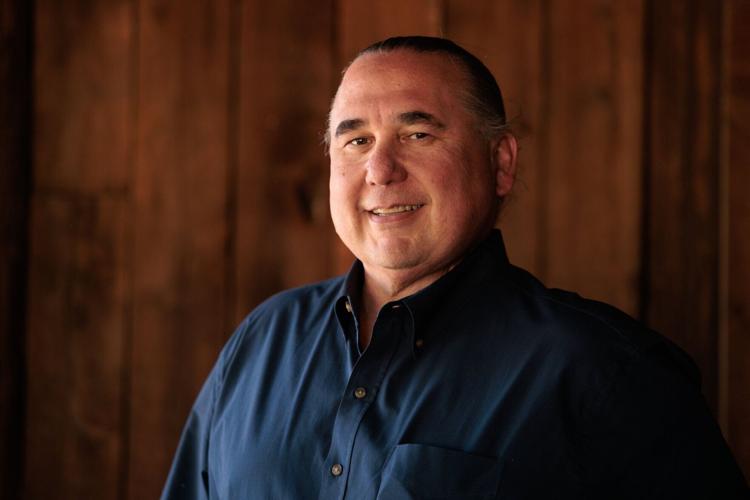
For Urban Eberhart, perhaps the highest-profile face of the project, it鈥檚 all but an inevitability.
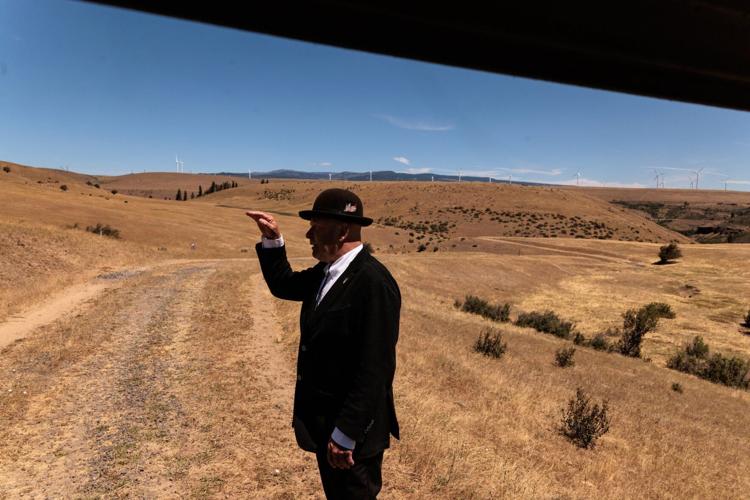
He stood before the aspen grove in a dark, woolen suit, bowler hat atop his head, proud to share his vision that would bring more water to the arid landscape of Central Washington.
鈥淗ere we are,鈥� Eberhart said, arms outstretched. 鈥淯nderwater.鈥�
Springwood Ranch
The 3,600-acre Springwood Ranch, just north of Interstate 90, has changed hands several times in recent decades.
There鈥檚 a party barn on the property for high school graduations, weddings, you name it. In a more remote plot near the Yakima River, abandoned buildings molder, remnants of a long-defunct boxing camp. For years, the property was owned by the founders of the Black Angus Steakhouse chain.
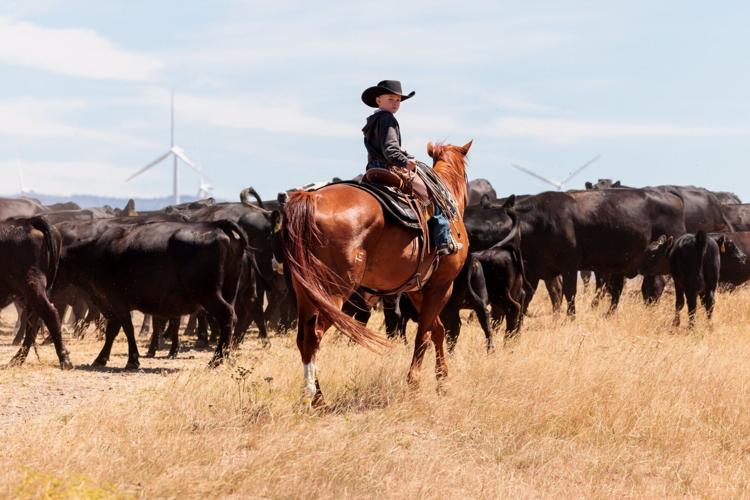
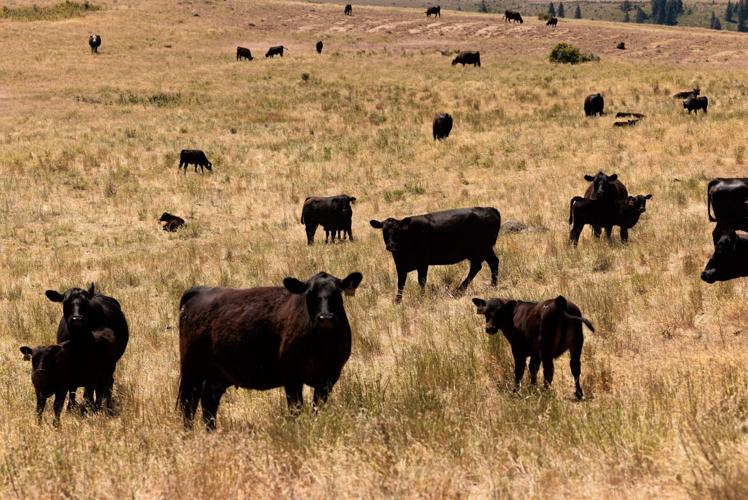
Now much of the property remains a working cattle ranch.

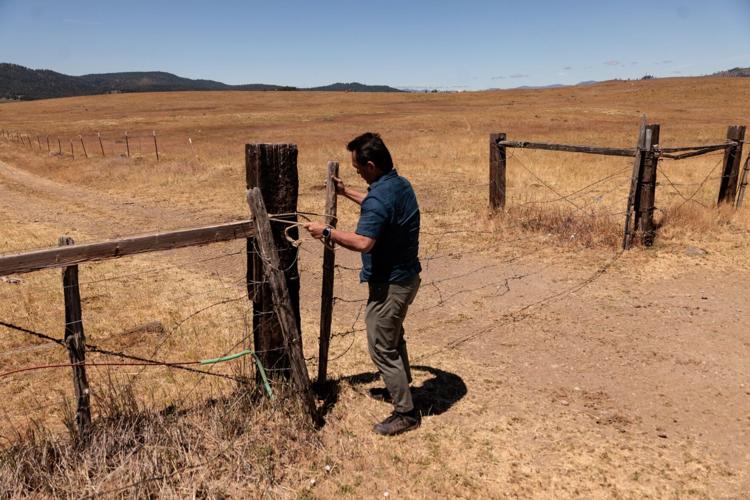
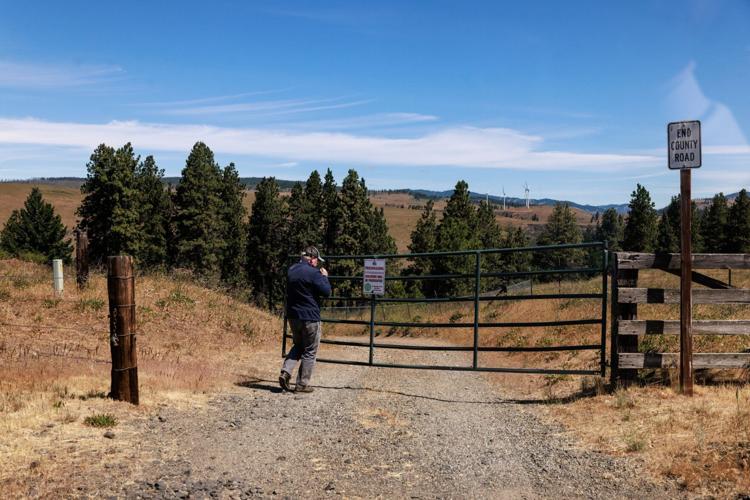
Peter Dykstra, with the Trust for Public Land, opens a gate at the Springwood Ranch, west of Thorp, Kittitas County, in late June. (Erika Schultz / The Seattle Times)
The ranch is in flux yet again as Peter Dykstra, an attorney representing the Trust for Public Land, and a slew of local and state officials draw and redraw new dividing lines across the acreage.
The trust bought the Springwood Ranch last March, an expense that will be reimbursed by Washington after the Legislature set aside $24 million (over two years) for the purchase.
The plan, Dykstra said, is to split the property into several portions going to the Kittitas Reclamation District, Kittitas County, the Yakama Nation and the state Department of Fish and Wildlife.
Each group for their parcels, which will be transferred to them in the weeks ahead. But the 1,600-acre plot on the property鈥檚 northwest side 鈥� earmarked for the Kittitas Reclamation District 鈥� is where the new reservoir would sit
Eberhart, who manages the reclamation district, said the idea is to build a relatively small dam between the basalt cliffs, just off the Yakima River. This would enclose the natural basin.
Then, earthen embankments raised around the perimeter would make for a consistent elevation around the site, he said.
Water would flow into the reservoir from an upstream intake site already in use by the reclamation district, and it would flow back into the Yakima River through the dam, which could potentially include hydropower turbines, Eberhart said.
There鈥檚 a bit of labyrinthine process involved before the water starts flowing, though. Multiple studies are needed, as is federal approval. But if it all goes according to plan and the reservoir is indeed built, Eberhart said his district would eventually hand over the site to the U.S. Bureau of Reclamation, which would then own and operate the reservoir, and possibly have a role in constructing the project.

Mike Livingston, regional director for the Washington Department of Fish and Wildlife, walks at the Springwood Ranch. (Erika Schultz / The Seattle Times)
A new reservoir
Ask any of the folks huddled around Eberhart the central question behind the reservoir and they鈥檒l each cough up the same answer.
What鈥檚 the water for?聽
For fish, of course, they say.
How could this be? Don鈥檛 dams and reservoirs typically block migratory routes for salmon, trout and others? Certainly that鈥檚 the case with other dams in the region, which have salmonid populations.

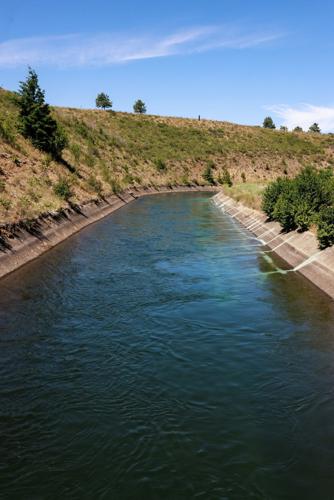
Water passes through canals on the Springwood Ranch. (Erika Schultz / The Seattle Times)
Climate change also exacerbates the issue. As the Earth鈥檚 atmosphere warms, precipitation that once fell as snow will .听
We鈥檙e already seeing the phenomenon. It鈥檚 posing a risk to the state鈥檚 water supply and posing a risk to farms and hydropower operations. Washington鈥檚 system of waterways isn鈥檛 designed to capture as much winter rainfall as is needed, so much of that extra rain runs out to sea. This translates to dwindling stream flows in the summer months and, in turn, , both of which severely threaten aquatic species.
Another reservoir could capture that extra water during the wet months and hold it for later in the year when it鈥檚 most needed, said Phil Rigdon, superintendent of the Yakama Nation鈥檚 Department of Natural Resources.
The project would avoid blocking fish on the Yakima River because it would be built outside of the waterway in what鈥檚 called an off-channel reservoir.
This way, by the time the snowpack is melted and stream flows dwindle, federal officials could release the extra water and give declining fish populations an added boost, Rigdon said.听
If it all comes together as planned, that added water could mean 鈥渂ig runs鈥� of sockeye, spring Chinook and steelhead back in the Yakima River, Rigdon said.听
鈥淭wenty years from now, with this thing running, we鈥檙e going to start seeing hundreds of thousands of fish coming back,鈥� Rigdon said.听
Fish served as a main draw for the Yakama Nation to sign on to the project. In past years the tribe often stood on opposite sides of the reclamation district or the county, Rigdon said. Banded together, the group makes for a stronger coalition in favor of the reservoir.

Phil Rigdon, superintendent of Yakama Nation's Department of Natural Resources, in June at the Springwood Ranch. (Erika Schultz / The Seattle Times)
Plus, Rigdon noted, the Yakama Nation will also receive a portion of the Springwood Ranch, which it will use to gather traditional medicines and .
Fish aren鈥檛 historically a forefront issue for high desert farmers, like those depending on water from the reclamation district, but they鈥檒l get something out of this deal too: billions of gallons of water.
Water released for the fish likely won鈥檛 come from the Springwood Ranch reservoir, Eberhart said. Rather, it would come from farther upstream.听
It helps to think of all the lakes on the Yakima River 鈥� like Keechelus, Kachess and Cle Elum 鈥� as one big pool of water, held in storage for when it鈥檚 needed. Adding another reservoir would increase the total amount of water available for fish, cities and farmers. Whether a particular drop of water comes from one lake or another is less important, Eberhart said. It鈥檚 all part of the same system.
So in this case, water added into the storage system for fish would also mean more water for irrigators downstream, Eberhart said.
Indeed agriculture is a of the economy in the Yakima River Basin, and many of those farmers face substantial cuts to their water supply in the dry years, with some expecting .听
A new reservoir at Springwood Ranch would be mutually beneficial for fish populations and those farmers, Eberhart said.
But therein lies the catch for those who question the project. They point to a longer history within the basin of pie-in-the-sky proposals with questionable benefit.

Cattle graze at the Springwood Ranch in June. (Erika Schultz / The Seattle Times)
The Yakima Basin Integrated Plan
The Springwood Ranch project and a slew of others are all part of a larger vision for the region, all outlined in a massive and controversial document called the .
The document is more than a decade old at this point, built on research stretching back even further. Within it are many projects, like expanding Bumping Lake, raising the water level at Cle Elum, a pumping plant at Kachess Lake and yet another reservoir at Lmuma Creek, all of them meant to increase the amount of water storage in the region.
Despite the ambitions, only is underway.听
The whole plan meant to add enough water to the Yakima Basin to nearly fill a site the size of Kachess Lake by next summer, but that was overly optimistic, said Tom Tebb, director of the state鈥檚 Office of the Columbia River.
There was another problem, too. A commissioned by the Legislature found that none of the projects would provide enough value to justify their high costs. The total package would cost than the benefits it would provide.
Tebb, Eberhart and many others take issue with that analysis, led by , director of Washington State University鈥檚 Water Research Center. They say his math was faulty and he failed to examine the projects as pieces of a whole, instead only examining them at face value.听

The 3,600-acre Springwood Ranch is west of Thorp, Kittitas County. (Erika Schultz / The Seattle Times)
Either way, the Springwood Ranch reservoir wasn鈥檛 included in the analysis; the project came on the scene much later. But for Jay Schwartz, a member of the local group Friends of Lake Kachess group, Yoder鈥檚 logic still applies.
If the objective is to help fish, the money (almost certainly hundreds of millions of dollars) would be better spent on fisheries, conservation programs or other projects, Schwartz said.
Schwartz also questioned the value of heavy public subsidies for a project that will benefit farmers growing forage crops like hay or alfalfa. The water to grow them often costs more money than the crops themselves return, he said. Plus, much of the crop is anyway.
Eberhart acknowledges that the majority of land in his district grows pasture crops like hay, but that demographic is changing to include more profitable crops like cherries. He pushed back on Schwartz further.
To keep the agriculture sector alive in the Yakima River Basin, the reservoir is a necessity, Eberhart said. In turn, the construction of towns, highways, railroads and more over past centuries has blocked the flow of smaller streams and tributaries throughout the region, he said. Irrigation from farms is now needed to keep that water flowing and to maintain the new hydrologic balance on which the ecosystem relies.
鈥淵ou鈥檒l never make it like it was before,鈥� Eberhart said. 鈥淔ish need farms, farms need fish.鈥�
For his part, Yoder stands by his analysis. He also largely abstained from presenting an opinion on the Springwood Ranch reservoir. The project could be proven as cost-effective, but, he said, that鈥檚 a high bar to clear.
What鈥檚 next?聽
Aside from the existential question of whether the Springwood Ranch reservoir would be worth the money, even more basic questions remain for David Ortman, a retired environmental lawyer.听
How big would the reservoir be? How much would it cost? Who would pay the bill? What would be the environmental impact of a new body of water near the eastern foothills of the Cascade Mountains?
All in due time, Eberhart said. A nearly $21 million feasibility study (funded half by the state and half by the U.S. Bureau of Reclamation) is underway. That study will show just how much water could be stored on-site.
The current estimates range from 30,000 to 90,000 acre-feet, Eberhart said. That would be about 10 to 30 times the volume of Green Lake in Seattle. Even on the high end, the new reservoir would hold less than half of a full Kachess Lake.
The potential size of the reservoir will give way to the cost, Eberhart said. From there, the feasibility study and the options it lays out will head to the U.S. secretary of the interior for approval. Then, a cost-benefit analysis and an environmental-impact statement would be needed.
However it shakes out, the project would almost certainly cost hundreds of millions, a bill that would be split down the middle by Washington state and the federal government.
The feasibility study should be finished in the next three years, and, if everything works out, Eberhart said a portion of the Springwood Ranch could be underwater within a decade.







(0) comments
Comments are now closed on this article.
Comments can only be made on article within the first 3 days of publication.