


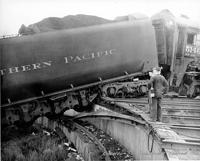



The Northern Pacific Railway not only influenced the development of Yakima鈥檚 Upper Valley, but it also opened up the Pacific Northwest to settlement and commerce.
The railroad was part of the effort to span the continent with rails, making it easier, faster and cheaper to move people and goods from one coast to the other.
Its story begins in the waning days of the Civil War, when Congress chartered the company with the goal of constructing a rail line between St. Paul, Minn., and the Puget Sound.
Under the charter, approved by President Abraham Lincoln, the railroad had until July 4, 1876, to complete the line. As an incentive, the government awarded 60 million acres in land grants along the route for development.
At that time, moving around the Pacific Northwest involved using wagons pulled by horses or oxen to get over steep mountain passes, or boats to navigate the rivers or the ocean. Dairy farmers in western Oregon used a schooner to bring cheeses and dairy products to Portland to sell, a fact memorialized on Tillamook Cheese鈥檚 logo.
While Union Pacific and the Central Pacific railroads completed the Transcontinental Railroad on May 10, 1869, the Northern Pacific was plodding along, hobbled by a lack of funding as potential investors worried about building a railroad into a sparsely inhabited area known for harsh winters.
But in 1870, Philadelphia financier Jay Cooke put up his fortune to build the railroad, with work starting simultaneously in Duluth, Minn., and Kalama, Wash.
The growing city of Seattle, realizing the benefits of being the terminus of a rail line, offered the railroad 7,500 town lots, 3,000 acres, $50,000 in cash, $200,000 in bonds and a 30-foot-wide swath of property along the waterfront in return for getting the terminal. The offer got Seattle on the short list, but the Panic of 1873 wiped out Cooke鈥檚 fortune and bankrupted the company, and the terminus eventually went to Tacoma.
It would not be the only time that a city felt snubbed by the Northern Pacific.
The railroad鈥檚 bankruptcy during the Panic of 1873 delayed extension from the Kennewick area to Yakima City 鈥� today鈥檚 Union Gap. But in 1881, Henry Villard raised 鈥�$8 million to buy the railroad and get the project back on track, although the congressionally mandated deadline was lost 鈥� along with some of the land offered by the government.
While Villard did a ceremonial 鈥渇inal spike鈥� driving in Montana in 1883, there was still work to finally link the railroad to Puget Sound, by way of the 黑料福利社.
In 1884, the railroad finally arrived in Yakima City, amid much public celebration. But railroad officials said the county seat was too small and potentially too swampy for a railroad depot. Instead, they picked a place 4 miles north to establish a depot and offered free land to any Yakima City residents who would move their businesses to the new community, which they dubbed North Yakima.
Some believed the railroad really wanted to start a town from scratch, where it would have greater sway.
So, in 1885, the move began, with a boxcar serving as a temporary depot for the railroad. The work continued, with the rails crossing the Cascades at Stampede Pass.
By 1893, the railroad was finally complete, linking the Puget Sound area to the Midwest.
At the height of its operation, the Northern Pacific had 6,800 miles of railroad, consisting of 2,831 main line miles and 4,057 miles on secondary lines.
In 1967, the Northern Pacific, Great Northern, and the Chicago, Burlington and Quincy railroads merged into the Burlington Northern Railroad. It later merged with the Atchison, Topeka and Santa Fe railroad to form Burlington Northern & Santa Fe Railway, now known as BNSF Railway.
The name lives on with the Northern Pacific Railway Museum in the former depot at Toppenish, where the history of the railroad is celebrated.
听
鈥� It Happened Here is a weekly history column by 黑料福利社 reporter Donald W. Meyers.







(0) comments
Comments are now closed on this article.
Comments can only be made on article within the first 3 days of publication.