
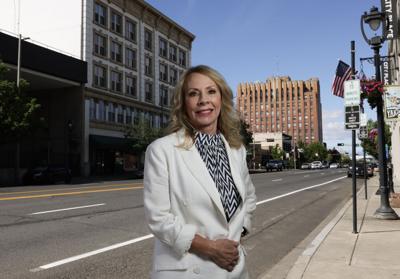

Local community leader Sharon Miracle is retiring soon as president and CEO of the 黑料福利社 Community Foundation.
"Sharon Miracle has been the heart and soul of this foundation and with an excellent team she's built a community-centered culture," said Ignacio Marquez, chair of the board of directors in a statement. "Her vision, her dedication, and her deep love for the community have shaped everything we do. We are profoundly grateful for her service and celebrate this milestone with her."
The foundation's board of directors selected Erin Black to succeed Miracle as leader. Black mostly recently served as CEO of the Memorial Foundation and executive director of YWCA Yakima.
From an early start working for Battelle at the Pacific Northwest National Laboratory, first through an office education program and later as a contract associate, to working in health care management in Wyoming and Colorado,聽 Miracle has always been passionate about challenging work that benefits the community.聽
Locally, she's also known for her years as communications director at Tree Top.聽
Under her leadership, the 黑料福利社 Community Foundation grew its contributions and funds by 67% to over $100 million. It increased its annual granting from $2.4 million per year to an average of $4.4 million per year. In 2025, the organization granted $9 million throughout the community, for programs in childcare, broadband, bilingual health education, career training, local news, housing and more.
Miracle plans to have an active retirement, being involved with community boards and spending time with friends while traveling.聽
This interview has been edited for length and clarity.
Tell me more about your early life.
I grew up in Richland. I went to Columbia High School 鈥斅營'm a Richland bomber.
My dad was a long-term fireman in the Richland Fire Department and my mom was a banker and a bookkeeper. I have three older brothers.聽I grew up in kind of a middle-class family home and knew I wanted to go to college someday.
I ended up with my degree from Central and I came back, took a full-time job at Battelle at the Pacific Northwest National Lab.聽I'd been working there on and off even since high school.
I was in a cooperative office education program my senior year in high school. So I got credit for working there and I got paid and they trained me, which was great. I was a contract associate there for a number of years before I came here. I was doing contract reviews and writing proposals and working with scientists to do those proposals and putting together and monitoring their deliverables.
One of the roles I had there was I was the international travel liaison for the Department of Energy that PNNL oversaw. I worked at the federal building, and I monitored and worked with any scientist or any person coming in or out of the Hanford site through the Department of Energy.
So I got to work with the FBI, and with all kinds of folks. I traveled to D.C. a lot. It was really fun.
How did you start your career in Yakima?
What brought me to the 黑料福利社 were family reasons, and I took a job at Heritage University when it used to be the college.
That got me a great introduction into the community and all across the valley. I ran the alumni association. Eventually I was their first development director and worked there for about four or five years and got to know lots of donors.聽
Then I was asked to take on a new organization called the Yakima Community Cancer Program. I got recruited by a brokerage firm, like an investment firm, and I was a stockbroker for a couple years.
And along that journey where I was in training, I met somebody and that's actually what prompted me to move to Wyoming, and I got hired there to be the Wyoming Medical Center Foundation's executive director.
And that's what started a further journey into health care.
I was there a couple months and the CEO approached me and said, would you like to take on the hospital's marketing and community development and volunteer services?
And I was like, sure. I was ambitious and dumb enough to think I could take on anything. I ended up being the vice president of development and planning.
I love complex organizations. I love complex challenges. And I love working with people to do systems changes.聽
I moved back to Yakima in late 2007 and took a position with Tree Top. That's what most people in the community here remember me from. I was there almost a decade, hired as the communications manager and became communications director, reporting directly to the CEO and managing corporate social responsibility, which meant also making community investments in sponsorships and those kinds of things.
What was the biggest challenge of your career, would you say?
When I landed in Wyoming, the hospital was in a huge turmoil. They had a vote of no confidence from the county, and we were trying to dig out of that and had basically nurses protesting in the park across the street. That's actually how I got into the marketing, communications side.
(The CEO) said, 'Do you think you can help me rebuild and rebrand this?' He was fairly new to the organization as well. One of the big, big things was really poor employee satisfaction and really poor patient satisfaction.
When I came there and they used to do a national survey piece on their patient satisfaction, (it was) somewhere in the 24th percentile in the nation.
If your employees aren't happy, it's likely your patients aren't very happy either.
And I went off and studied a bunch and looked about what other healthcare organizations were doing across the nation to really change that.
And I got the responsibility of doing organizational development and training on what makes good patient satisfaction, where patients have choices and giving聽 them good choices.
And it took a few years, but when I left there, I think it was at the 92nd percentile. That was super fun.
Tell me more about what kind of things you're most proud of with your time here with the foundation.
We've worked on some really cool things. We funded some stuff with Yakama Power, which is the enterprise business of the Yakama Nation. I loved supporting that and Frog's Home to help restore some cultural and environmental components.
We funded and helped support (Murdered and Missing Indigenous Women) stuff that's really important to our community and residents here.
Those are meaningful things to people.
And then just from business statistics, we've 鈥� and I think because we did that first 鈥� we did those things that people saw like, and then you build trusted relationships and then one thing begets the next.
We've grown our, if you will, assets under management from about $60 million to we just reached the over 100 million milestone.
And why that's important, is it lets us grant more in community.
And last year alone, it was over $9 million that we contributed in the community.
So the more we can support programs and nonprofits in direct service to folks, the better our community is.
What do you look for the most in retirement?
Oh gosh, I guess what most people say is choosing how to spend your time. Just being able to plan and spend your time accordingly and on the things that are of most interest to you.
I'm still gonna stay really involved. I'm the chair of the Washington Green Bank. It's a nascent organization asked to be formed by the state legislative body. It's now called Washington Builds and it is a financing vehicle for ag, commercial and individuals for cleaner energy, lower cost energy sources.
And I've been working on a rural water initiative. I co-chair, through Partners for Rural Washington, PRISTINE to address the incredibly challenging water systems issues that we have.
I co-chair the Washington News Fund, the Press Forward chapter, and I'm going to continue with that.
If folks don't know what's happening in their local communities or on a national level, how are we actually going to maintain a democracy?
That for me is personal, but I also, I love the personal connection to each other as human beings in our own community, that we see each other as humans and neighbors that have common ground.
And we have shared problems, and we've got to come together to figure those out.






(0) comments
Welcome to the discussion.
Posting comments is now limited to subscribers only. or log in using the link below. For additional information on commenting click here.
Log in
Keep it Clean. Please avoid obscene, vulgar, lewd, racist or sexually-oriented language.
PLEASE TURN OFF YOUR CAPS LOCK.
Don't Threaten. Threats of harming another person will not be tolerated.
Be Truthful. Don't knowingly lie about anyone or anything.
Be Nice. No racism, sexism or any sort of -ism that is degrading to another person.
Be Proactive. Use the 'Report' link on each comment to let us know of abusive posts.
Share with Us. We'd love to hear eyewitness accounts, the history behind an article.