
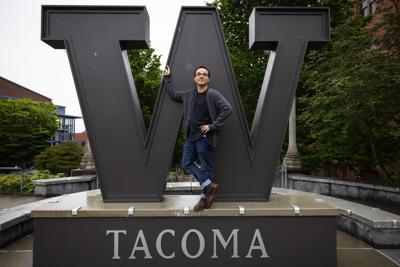
TACOMA — Noah Herd fell in love with computers as a kid.
He taught himself to fix his family’s desktop when it broke and, after learning a programming language, built a video game on his own.
But it wasn’t until years later, when he took notice of tech companies offering six-figure salaries to programmers during the pandemic, that he seriously considered a career in coding.
“It’s cool to build things with software,” said Herd, a 30-year-old senior at the University of Washington, Tacoma majoring in computer science. “It requires more creativity than you think.”
But as his graduation fast approaches later this week, Herd has watched as the industry he hopes to enter undergoes a bruising series of layoffs. Since the start of spring, pink slips have claimed 30,000 jobs at Oracle, , and — closer to home — Microsoft announced .
“It’s not looking good,” Herd said after attending an April career fair at UW Tacoma, where, despite the shaky outlook, tech recruiters still drew the longest lines. “I want to be a software engineer, and I’m still pushing for that. The reality is I have to pay rent.”
Software development consistently ranks among the jobs that artificial intelligence is over the next decade, with customer service, graphic design, accounting and data entry also topping the vulnerability lists. Entry-level workers and those in Generation Z also could be hit hard, as experts predict AI will most easily automate the type of repetitive work they tend to do starting out.
Last fall, the for recent college graduates reached its highest rate in five years, and recent labor market data shows a for 22- to 25-year-olds in jobs “most exposed” to AI. Handshake, a recruiting and early-career platform, reported that the number of full-time jobs posted to its site 2% from last year and 12% below prepandemic levels.
Still, students like Herd, as well as economists, hesitate to blame AI, at least entirely, for the class of 2026’s woeful job prospects. Many students set to graduate this year already hedged their hopes for finding work in a persistently “low hire, low fire” economy, noting they will now compete with recently laid off workers and those who can’t afford to retire. Labor experts say AI much entry-level or white-collar work just yet, even as the technology injects more uncertainty into an already tight market.
Colleges, meanwhile, have tried to keep pace with the rapid change too. Many have built AI into their career services, and counselors regularly advise students to learn how to use the technology to increase their competitive edge. They’re also emphasizing the importance of networking and soft skills — such as communication and critical thinking — that AI can’t easily replace.
"Technical skills may come and go, change and evolve. We’re not teaching the same things in agriculture that we did 25 years ago,” said John Woods, provost and chief academic officer at the University of Phoenix. “But we are still teaching judgment, critical thinking, teamwork."
Some advisers and students raised worries that AI could reinforce existing inequities that allow the wealthy and well-connected to secure the best, and perhaps only, jobs left for humans to fill.
“The effects of AI on labor markets are obviously evolving as we speak,” said Steven Durlauf, a University of Chicago economist who studies human capital and wealth inequality. Young workers “lack clarity about the world they’re entering, and when you don’t know all the probabilities, people tend to assume the worst.”
At the UW Tacoma job fair, many computer science majors, including Herd, waited in a pair of long lines to speak with Anshul Bhandari.
Bhandari represented Infoblox, a private cloud-computing firm, and was recruiting for both internships and full-time positions. The company already uses AI bots in lieu of humans to conduct initial interviews with job applicants, and has shifted much of its actual programming to AI.
“I see AI as an enabler, not job-killer,” he said. “We still need human oversight — at least for the foreseeable future.”
Students shared a range of perspectives on their job prospects.
Ibadat Sandhu, a computer science major, hopes to work in cybersecurity. At least in her planned field, the 22-year-old has noticed more recruiters who now require two to three years of experience for entry-level positions.
“Even with internships, they’re getting more specific with what they want from students,” said Sandhu. “I don’t even have four years here [at college] yet. Where do I get that experience?”
Monika Rani hopes she can find work in finance before AI eliminates most jobs in the field. The 35-year-old recently moved from Pakistan to pursue a master’s degree in accounting at UW Tacoma and has read articles about the uncertain labor market.
“We still need humans to double check and oversee AI,” she said. “It’s useful now, but still contains errors. It’s not 100%.”
In a recent from the National Association of Colleges and Employers, or NACE, a majority of employers said they’re not looking for AI skills on resumes just yet. But the respondents said an average of 35% of their entry-level jobs do require some proficiency in the technology.
Nearly 3 in 5 employers also said they’re assigning AI-related work to interns. “We’ll continue to see a lot more of that,” said Mary Gatta, NACE’s director of research and public policy.
Jonathan Wright, director of career services at the College of Southern Nevada, said the rapid introduction of AI in the workplace has only underlined his longtime advice that students pursue more training — whether it’s externships, certificates or formal degrees — to make their résumés stand out.
Now, though, additional education might mean training how to work with AI agents.
“Employers still need the humans to manage all these AI tools,” he said. “The human element is still there. Stop running from the technology. Embrace it, and add it to your tool belt.”
On whether AI will exacerbate the existing digital divide, Wright said he was an optimist: “Instead of trying to figure it out on your own or doing your best without a mentor, AI can give you some steps and tools. You at least have a starting point now.”
Not everyone shares his optimism.
Amanda Figueroa, associate vice chancellor for social mobility at UW Tacoma, noted employment opportunities and outcomes are already stacked against certain workers, such as Black women. Research from that female, Black, Hispanic and first-generation college students are less likely to get paid internships, which can lead to well-paid entry-level positions and offer a chance to meet mentors.
If AI makes it even harder for students to get internships and entry-level work, Figueroa said, it’s very likely students will need to rely even more on social connections and interpersonal skills to secure job opportunities. “That risks reinforcing the good old boys’ network,” she said.
The weekend before finals in early June, Herd said he had mixed feelings as commencement approached, proud to earn his degree but scared about the future.
He’s set himself a deadline of six months to find a job in computer science. If that doesn’t happen, he said he will consider joining the military.
“I really don’t want to do that,” he said, “but I need to be able to feed myself.”
Contact Hechinger Report staff writer Neal Morton at 212-678-8247, on Signal at nealmorton.99, or via email at morton@hechingerreport.org.
This story about was produced by , a nonprofit, independent news organization focused on inequality and innovation in education. It is published here as part of the . Sign up for the .







(0) comments
Welcome to the discussion.
Posting comments is now limited to subscribers only. or log in using the link below. For additional information on commenting click here.
Log in
Keep it Clean. Please avoid obscene, vulgar, lewd, racist or sexually-oriented language.
PLEASE TURN OFF YOUR CAPS LOCK.
Don't Threaten. Threats of harming another person will not be tolerated.
Be Truthful. Don't knowingly lie about anyone or anything.
Be Nice. No racism, sexism or any sort of -ism that is degrading to another person.
Be Proactive. Use the 'Report' link on each comment to let us know of abusive posts.
Share with Us. We'd love to hear eyewitness accounts, the history behind an article.